FILMLAB · Screening
FilmLab speaks the language of analog film: exposed, developed, printed. Ten stages from the idea to the positive. This page shows them — and proves three of them on a real shot.
The finished screenplay from Script Studio comes in at stage ②. Everything before it is preparation, everything after it is production.
The story, the people, the places. What a team settles at the table before a camera is set up.
This is where something you can watch is made — and this is where the proof further down begins.
Shots become a sequence, and the sequence becomes a film in the formats someone approves.
Ten boxes look like a generator that turns prompts into clips. The opposite is true: the work lies in what comes after the first image — and that is craft, not a button.
Cast, props and foreground are created cut out once, arranged like a set and then combined — instead of rolling the dice on the whole image with every attempt.
Extras as a layer of their own with a ground anchor, plus an AI crowd filled directly into the plate. Whole rows and depth staging, without a separate shoot for every figure.
Murnau is the studio's editing environment; alongside it, the Cutter builds a finished timeline from the project data — editing as code, not as handwork from zero.
Controlled visual lip sync via face crop and mask composite. And because speech material is already there for the lip sync, it can be used to clone the voice.
Dialogue, music, effects, ambience — with automation, ducking, fades and room. A sound mix, not one volume slider over everything.
A project color profile that all material aligns to, and at the end delivery profiles: sRGB, Rec.709, DCI-P3, Rec.2020 — with HDR metadata.
One of these exists in this form only here. A continuity pass checks every shot against the previous one — and also against the reference sheets of the character and the location. The real adversary in AI film is not the wrong match cut but drift: the model draws the same character a little differently in every shot. An editing program would have to guess that from the finished footage. This studio knows what the character should look like, because it created the sheet itself.
Instead of hinting at ten stages, we take a single shot and show each step with what actually came out — including price and runtime.
SC 04 — EXT. BALCONY, MORNING. “She smokes, even though she has quit.” The scene sits between a night and the morning after; a chamber piece about two people who have shared an apartment since the relationship ended.
Slugline and scene text become a direction: shot size, lens, light, and the two props that carry the scene.
Medium wide shot, 50mm, medium depth of field. Early morning on a narrow concrete apartment balcony. A woman in her late thirties, still in yesterday's clothes, stands at the railing holding a cigarette low and away from her body, as if it belonged to someone else. No ashtray — a chipped coffee saucer balanced on the railing. Behind her a sliding glass door stands half open onto an unlit living room; the interior reads as a black rectangle against the pale sky. Overcast dawn light, 5600K, soft and directionless, no sun, no golden hour. Cold desaturated palette. Fine 35mm grain, natural available light only. Composition boxed in by the railing and the door jamb — she is enclosed even outdoors. Observational, still, unsentimental.
Someone who has quit no longer owns an ashtray — hence the saucer. The relapse is in the prop, not in the face.
Two passes. The first hit the look, but the light read as evening instead of morning. The second changed only the light — composition, location and posture stayed untouched.
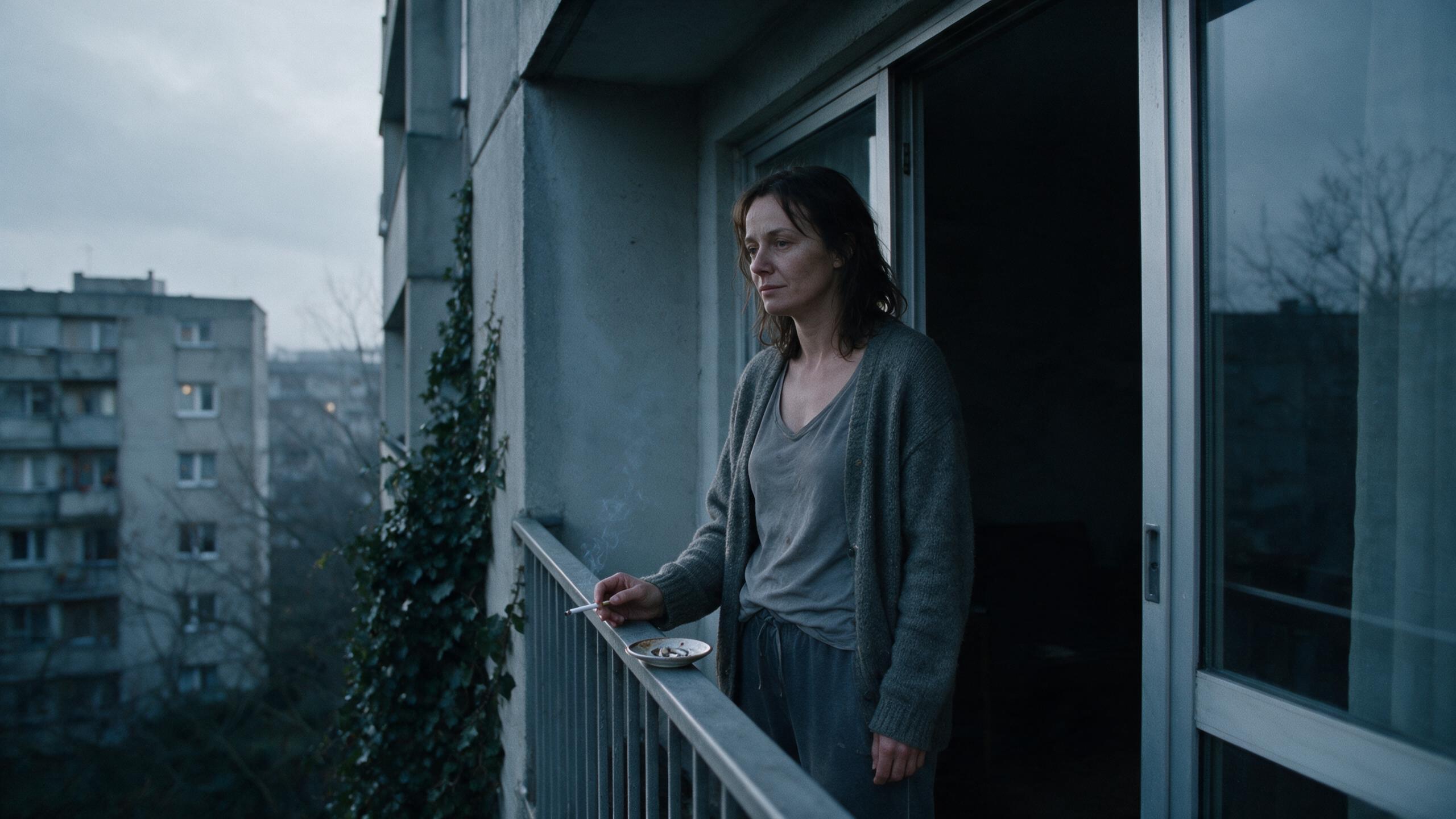
The still image is set in motion. The instruction reads: the camera stays still. Only the smoke and the ivy may move — and her hand, once.
The same shot, the same start image, the same instruction, through three models. What we measured was whether the frame really stays still: image noise in the unmoving background, first frame against last. The higher the value, the steadier the camera.
| Model | Credits | Length | Resolution | Ton | Frame | Verdict |
|---|---|---|---|---|---|---|
| Veo 3.1 fast | 60 | 8,0 s | 1080p | ja | 20,1 dB | drifts clearly |
| Gemini Omni Flash | 80 | 10,0 s | 720p | ja | 36,1 dB | slight floating |
| Seedance 2.0 | 400 | 10,0 s | 1080p | nein | 40,3 dB | Frame holds |
The most expensive model holds the frame best — and is silent. The cheapest delivers only 8 of the 10 seconds ordered and pushes the camera away, although the opposite was asked for. The choice is the middle one: full length, sound, a fifth of the price — in exchange for a camera that breathes slightly, and 720p instead of 1080p, because this model does not let you control the resolution at all. This is not a ranking, it is a trade-off — and it comes out differently from shot to shot.
A screening may show things. It may not pretend to be something else.