FILMLAB · Findings
The evidence behind the manual: every measurement series with a date, every failure by name, and for almost every property of the product the measurement that caused it. If you want to know how to operate something, the manual is the right place; if you want to know why it is built this way and where it tips over, this is.
Three questions a product page has to answer before it shows anything. Here they come first — and the rest of the page backs them up.
From treatment to pitch-ready look: story, characters, locations, image, motion, edit, export. Not a tool for clips, but the stretch in between — and the connection to budgeting and proof of rights.
An afternoon instead of three weeks of concept work. The price is shown before sending, not on the invoice. And what the tool can do is measured and documented, rather than claimed.
Solo directors and writers with a treatment that has to become visual. Production companies of two to fifteen people that pitch three to ten projects a year. Commercials and corporate films, where a look concept has to exist before the shoot.
The reason people pay is not creativity but deadline pressure with money behind it: submission deadline, pitch date, client presentation. If you have to submit next week, you do not compare six tools — you pay to be pitch-ready by Friday.
And what it will not become, so you do not expect the wrong thing: not another model zoo, not a contest for the best video model, not a price war against flat-rate providers. If you only want clips off a conveyor belt, you are better served elsewhere for less. The value lies in the planning and in the DACH context.
The same order as in the screening, where a single shot runs through all the stages. Here is the overview.
The story, the people, the places. What a team settles at the table before a camera is set up.
Prompt, image, motion, sound. This is where what you can watch comes into being — and this is where the costs sit.
Shots become a sequence, and the sequence becomes a film in the formats someone approves.
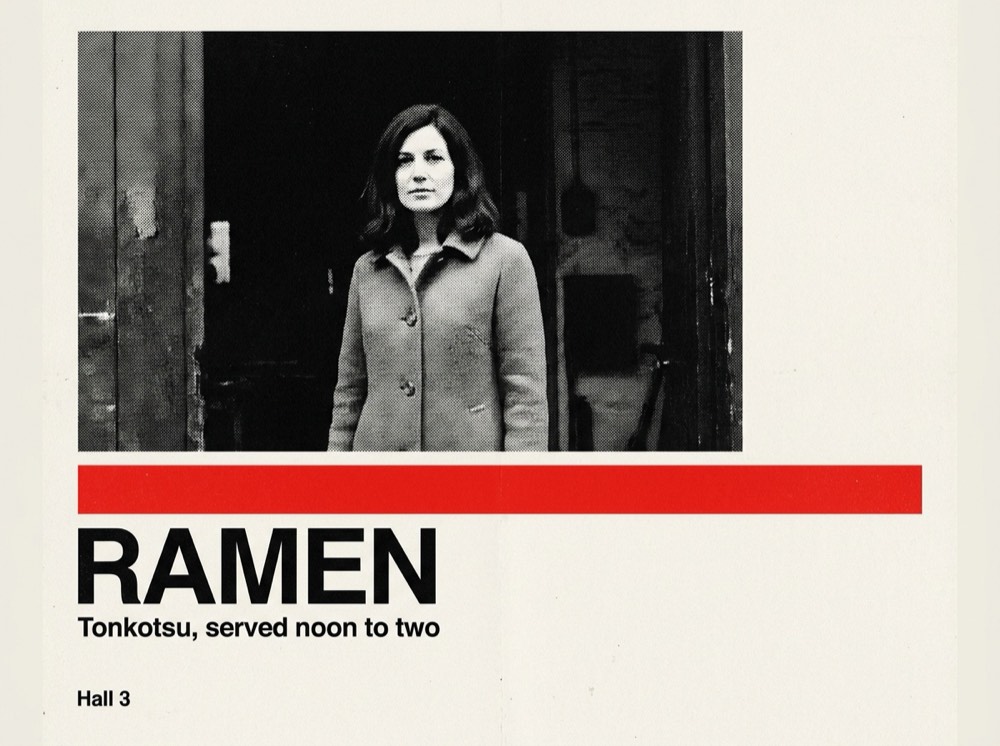
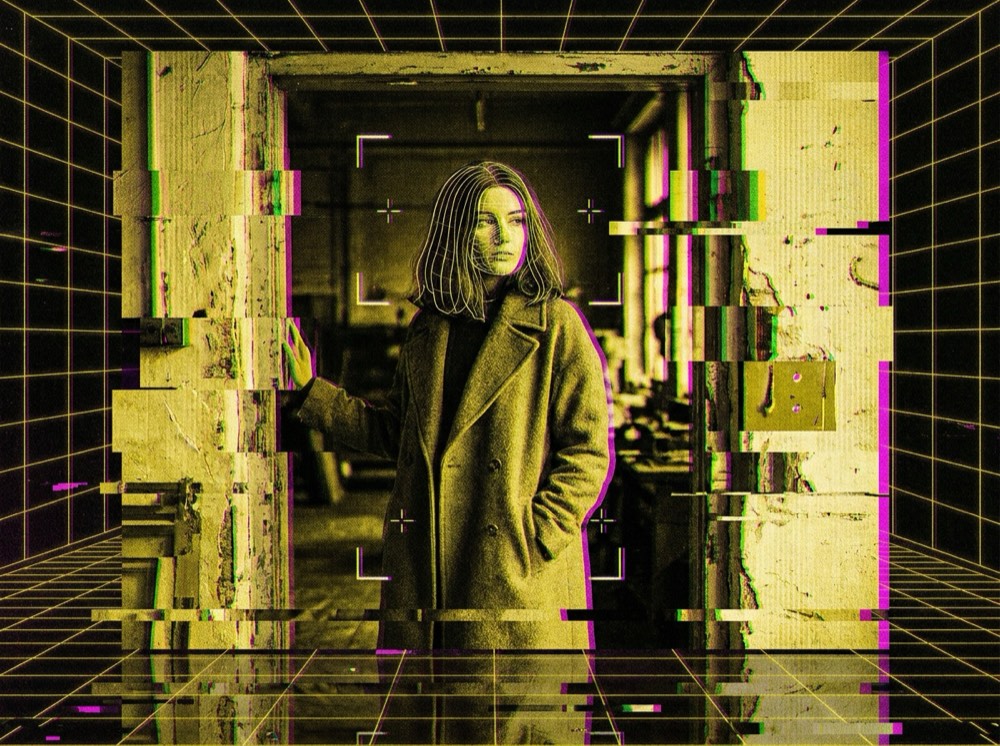
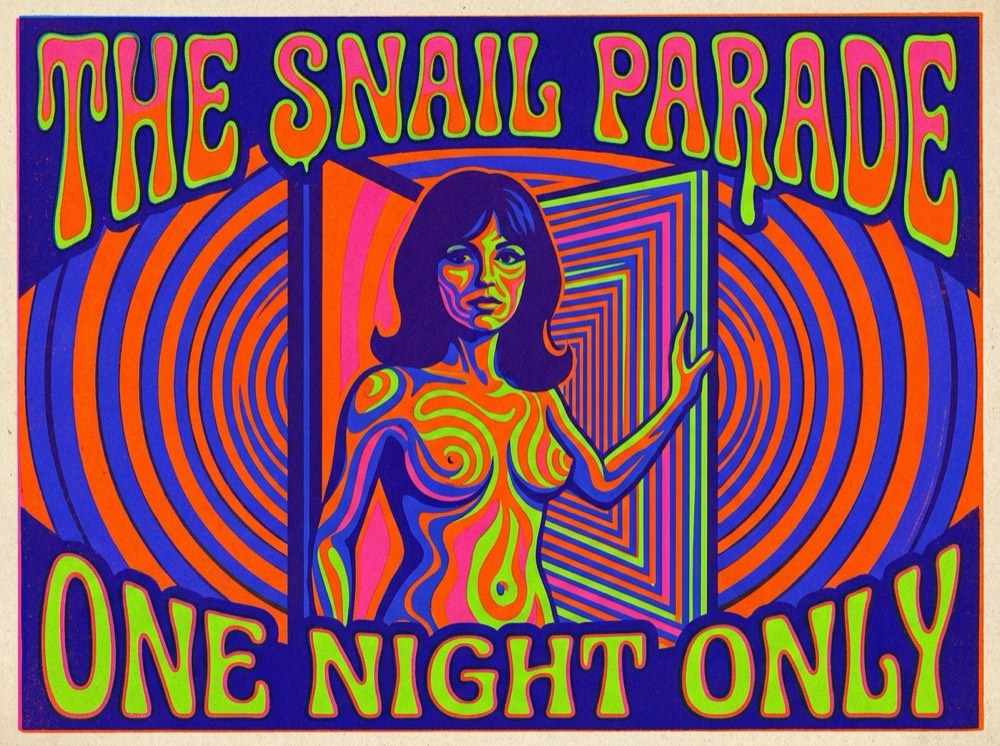
Film stocks (Portra, Cinestill, Tri-X …), cinematic looks and graphic styles that rewrite the whole image — Bauhaus poster, anime cel, blind embossing, screen print. Presets with fixed lettering have input fields: the words in the image are yours, not ours.
48 presets, each with a reference image of the same subjectCurated parameters instead of generic prompt wrappers: every preset carries the signature of a department. Immediately readable for film people, because it speaks the language of the set and not that of the model.
Exposure, contrast, hue, saturation, grain — as sliders, not as a prompt. The grade computes directly on the image: the same look hits every still the same way, reproducibly and without burning a Credit, because no model is guessing any more. “Start from the colorist brief” takes the look from the crew configuration as a starting point, and the sliders fine-tune on top. The same grade exists as the MCP tool lab_grade — an AI agent sets the look through the same sliders without opening the app.
70 looks. Twenty are designed freely, 17 of them named in three families:
Plus three technical ones for material that arrives as Cineon log (log-neutral, print-warm, print-kühl) — they expect log and output Rec.709; on normal material they look wrong.
The other fifty are reference looks, since September 27: each rebuilt after a specific film frame, from three key colors of the frame and our grade math — curve, saturation, grain — baked as its own LUT. In the console each one appears with its still and the exact details below: film, year, director, camera. It is chosen by the film, which is why the companion does not suggest it by subject. The full list is under the tools.
Applying is non-destructive — the original stays, the graded image is a new gallery row. The companion (pipeline agent) suggests a look and applies it on approval: guided in the console or in the chat (“which look suits this shot?”).
70 looks (20 designed freely, 50 after a film frame) · in the console, as MCP tool lab_grade, via the companion · deterministic, no AI Credits · live since 2026-09-21For each intent the router ranks by quality, caps the cost and, within a model family, takes the cheapest wired access. If it finds none under the cap, it says so with numbers — instead of quietly taking the most expensive model.
Price before sending, not afterTimeline, transport, two monitors, export. The shots from the pipeline land directly in it, without a detour through a download folder.
The app in the browser. An MCP server through which AI agents operate the same pipeline — 82 tools. And a bridge that runs inside DaVinci Resolve and since September 27 forms a shared facade with the MCP: an agent sees FilmLab and the open Resolve timeline at the same time. Anything that costs money runs there in two steps — first the price, then an approval that is valid only for exactly this call and for fifteen minutes.
App · MCP (OAuth or bridge key) · Resolve bridge 0.67 · details belowEach look carries the number under which it appears in the console (filmlab-ref-01 to -50). We show the stills only in the console, as evidence of what the look took its measure from; the rights to the images belong to the rights holders of the films.
| Nr. | Film | Year | Director | Camera |
|---|---|---|---|---|
| 01 | American Honey | 2016 | Andrea Arnold | Robbie Ryan |
| 02 | Drive | 2011 | Nicolas Winding Refn | Newton Thomas Sigel |
| 03 | Aftersun | 2022 | Charlotte Wells | Gregory Oke |
| 04 | Sicario | 2015 | Denis Villeneuve | Roger Deakins |
| 05 | Aftersun | 2022 | Charlotte Wells | Gregory Oke |
| 06 | The Florida Project | 2017 | Sean Baker | Alexis Zabé |
| 07 | The Florida Project | 2017 | Sean Baker | Alexis Zabé |
| 08 | Fish Tank | 2009 | Andrea Arnold | Robbie Ryan |
| 09 | Fish Tank | 2009 | Andrea Arnold | Robbie Ryan |
| 10 | Fish Tank | 2009 | Andrea Arnold | Robbie Ryan |
| 11 | This Is England | 2006 | Shane Meadows | Danny Cohen |
| 12 | This Is England | 2006 | Shane Meadows | Danny Cohen |
| 13 | This Is England | 2006 | Shane Meadows | Danny Cohen |
| 14 | Under the Skin | 2013 | Jonathan Glazer | Daniel Landin |
| 15 | Portrait of a Lady on Fire | 2019 | Céline Sciamma | Claire Mathon |
| 16 | Portrait of a Lady on Fire | 2019 | Céline Sciamma | Claire Mathon |
| 17 | The Master | 2012 | Paul Thomas Anderson | Mihai Malaimare Jr. |
| 18 | Blade Runner 2049 | 2017 | Denis Villeneuve | Roger Deakins |
| 19 | In the Mood for Love | 2000 | Wong Kar-wai | Christopher Doyle / Mark Lee Ping-Bing |
| 20 | In the Mood for Love | 2000 | Wong Kar-wai | Christopher Doyle / Mark Lee Ping-Bing |
| 21 | In the Mood for Love | 2000 | Wong Kar-wai | Christopher Doyle / Mark Lee Ping-Bing |
| 22 | Drive | 2011 | Nicolas Winding Refn | Newton Thomas Sigel |
| 23 | Buffalo '66 | 1998 | Vincent Gallo | Lance Acord |
| 24 | The Master | 2012 | Paul Thomas Anderson | Mihai Malaimare Jr. |
| 25 | Sicario | 2015 | Denis Villeneuve | Roger Deakins |
| 26 | Uncut Gems | 2019 | Josh & Benny Safdie | Darius Khondji |
| 27 | The Neon Demon | 2016 | Nicolas Winding Refn | Natasha Braier |
| 28 | Moonlight | 2016 | Barry Jenkins | James Laxton |
| 29 | The Florida Project | 2017 | Sean Baker | Alexis Zabé |
| 30 | Drive | 2011 | Nicolas Winding Refn | Newton Thomas Sigel |
| 31 | Good Time | 2017 | Josh & Benny Safdie | Sean Price Williams |
| 32 | American Honey | 2016 | Andrea Arnold | Robbie Ryan |
| 33 | Chungking Express | 1994 | Wong Kar-wai | Christopher Doyle / Andrew Lau |
| 34 | Chungking Express | 1994 | Wong Kar-wai | Christopher Doyle / Andrew Lau |
| 35 | Good Time | 2017 | Josh & Benny Safdie | Sean Price Williams |
| 36 | Good Time | 2017 | Josh & Benny Safdie | Sean Price Williams |
| 37 | Uncut Gems | 2019 | Josh & Benny Safdie | Darius Khondji |
| 38 | Uncut Gems | 2019 | Josh & Benny Safdie | Darius Khondji |
| 39 | Paris, Texas | 1984 | Wim Wenders | Robby Müller |
| 40 | Paris, Texas | 1984 | Wim Wenders | Robby Müller |
| 41 | The Neon Demon | 2016 | Nicolas Winding Refn | Natasha Braier |
| 42 | The Neon Demon | 2016 | Nicolas Winding Refn | Natasha Braier |
| 43 | Buffalo '66 | 1998 | Vincent Gallo | Lance Acord |
| 44 | Under the Skin | 2013 | Jonathan Glazer | Daniel Landin |
| 45 | Under the Skin | 2013 | Jonathan Glazer | Daniel Landin |
| 46 | Moonlight | 2016 | Barry Jenkins | James Laxton |
| 47 | Moonlight | 2016 | Barry Jenkins | James Laxton |
| 48 | Blade Runner 2049 | 2017 | Denis Villeneuve | Roger Deakins |
| 49 | Blade Runner 2049 | 2017 | Denis Villeneuve | Roger Deakins |
| 50 | Paris, Texas | 1984 | Wim Wenders | Robby Müller |
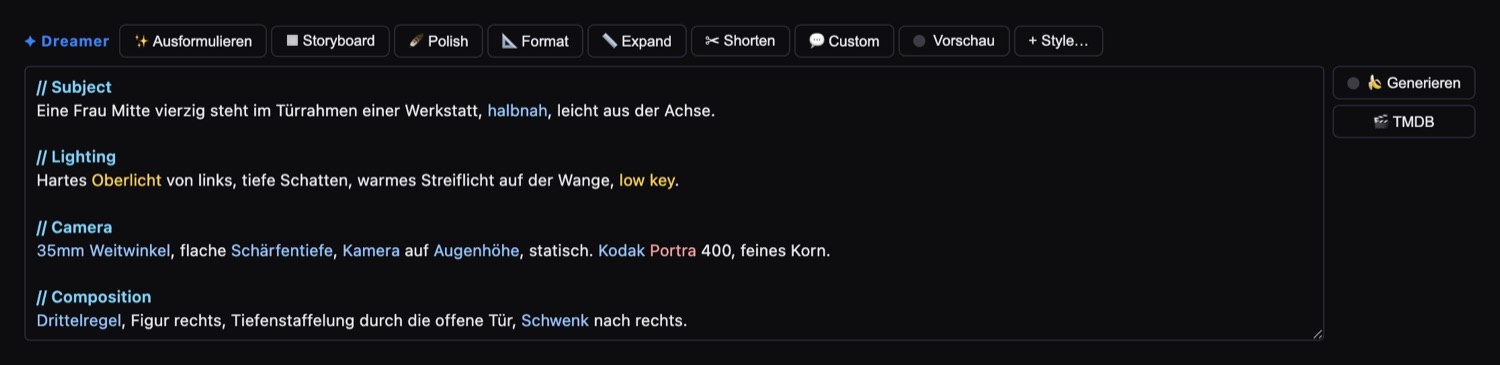
Every stage depends on the prompt, and the prompt is where most attempts get burned. That is why the Dreamer is not a text field but a toolbox.
Build a complete, structured prompt from an idea — light, optics, camera filled in instead of forgotten.
Break a scene into four to eight numbered panels, each a standalone image prompt with shot size and angle.
Structure into sections, smooth the flow of words, add cinematic details or cut by about a third — the core stays.
Light, optics, camera, material, color, composition, motion, style are colored in the text — fed by the film lexicon. You see what the prompt talks about and what it does not.
Film stocks, cinematic looks, graphic styles. Presets that put type into the image have input fields — the words in the image are yours.
A tiny test image for the prompt, for about a third of a cent. It is not saved; it only answers the question of whether the prompt holds up.
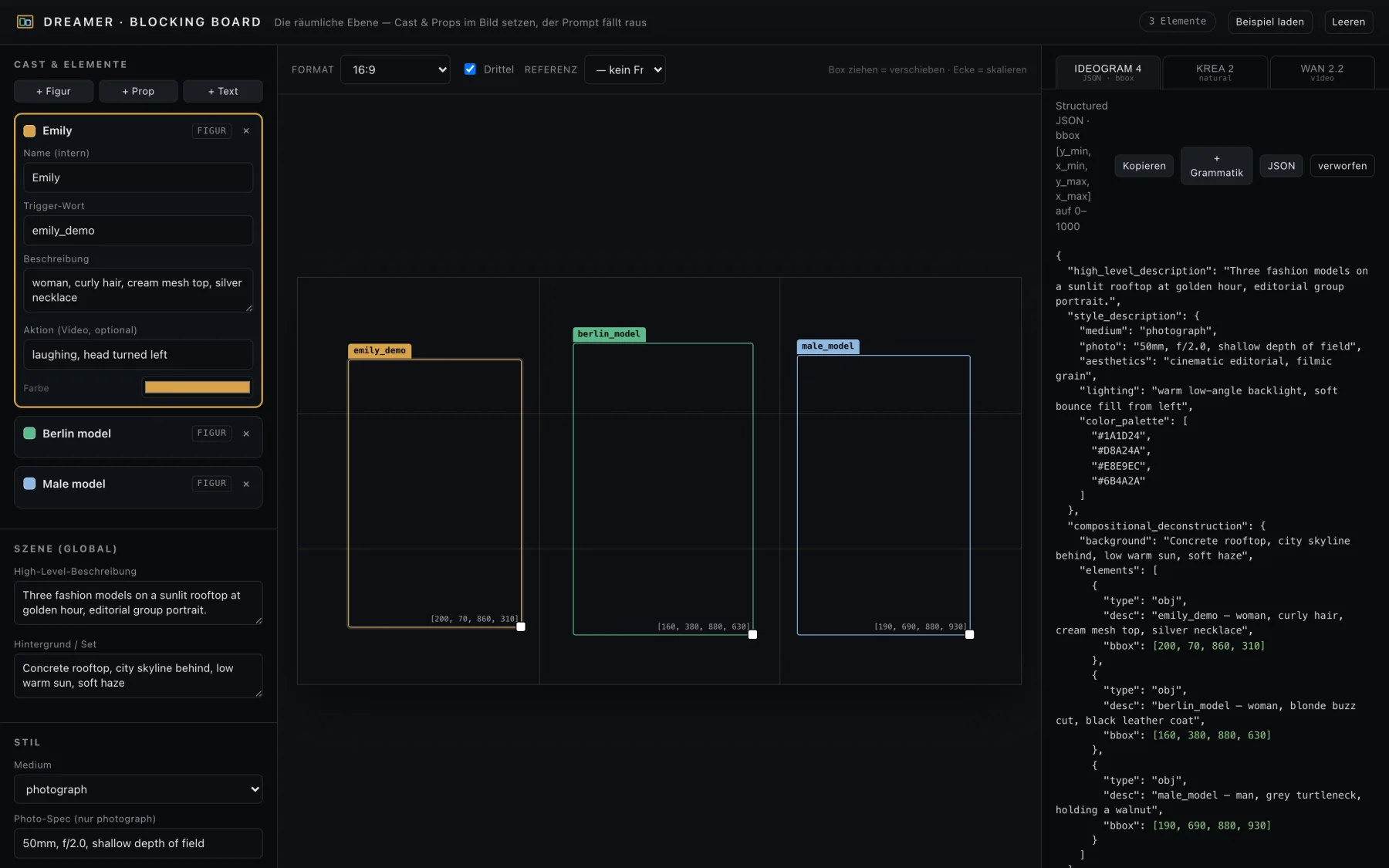
~$0.003 per lookIn the Blocking Board, characters and props are placed in the frame instead of described. The prompt falls out as a by-product — see below.
Every step can be undone, up to twenty back. If you experiment, you have to be able to go back, or you will not experiment.
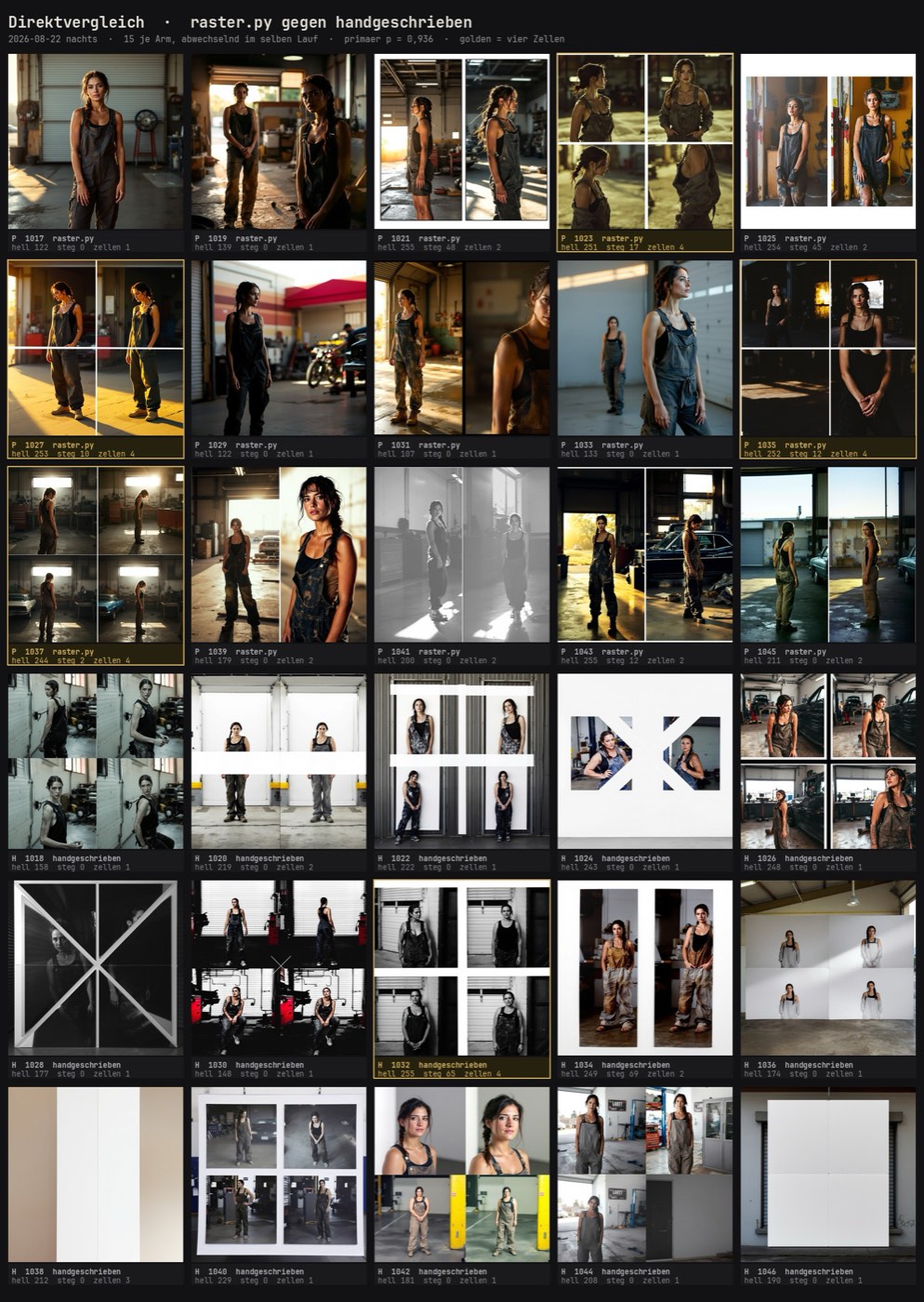
Why this is a toolbox and not an autopilot: we measured whether a handwritten prompt holds up better than a generated one — 110 throws, three attempts, no difference. So the tools do not conjure up quality; they save attempts. That is the honest claim, and it is worth more than the other one.
Almost every property here has a measurement as its cause — often one that went against our own expectation. The row from left to right: when, what was measured, what it became in the product.
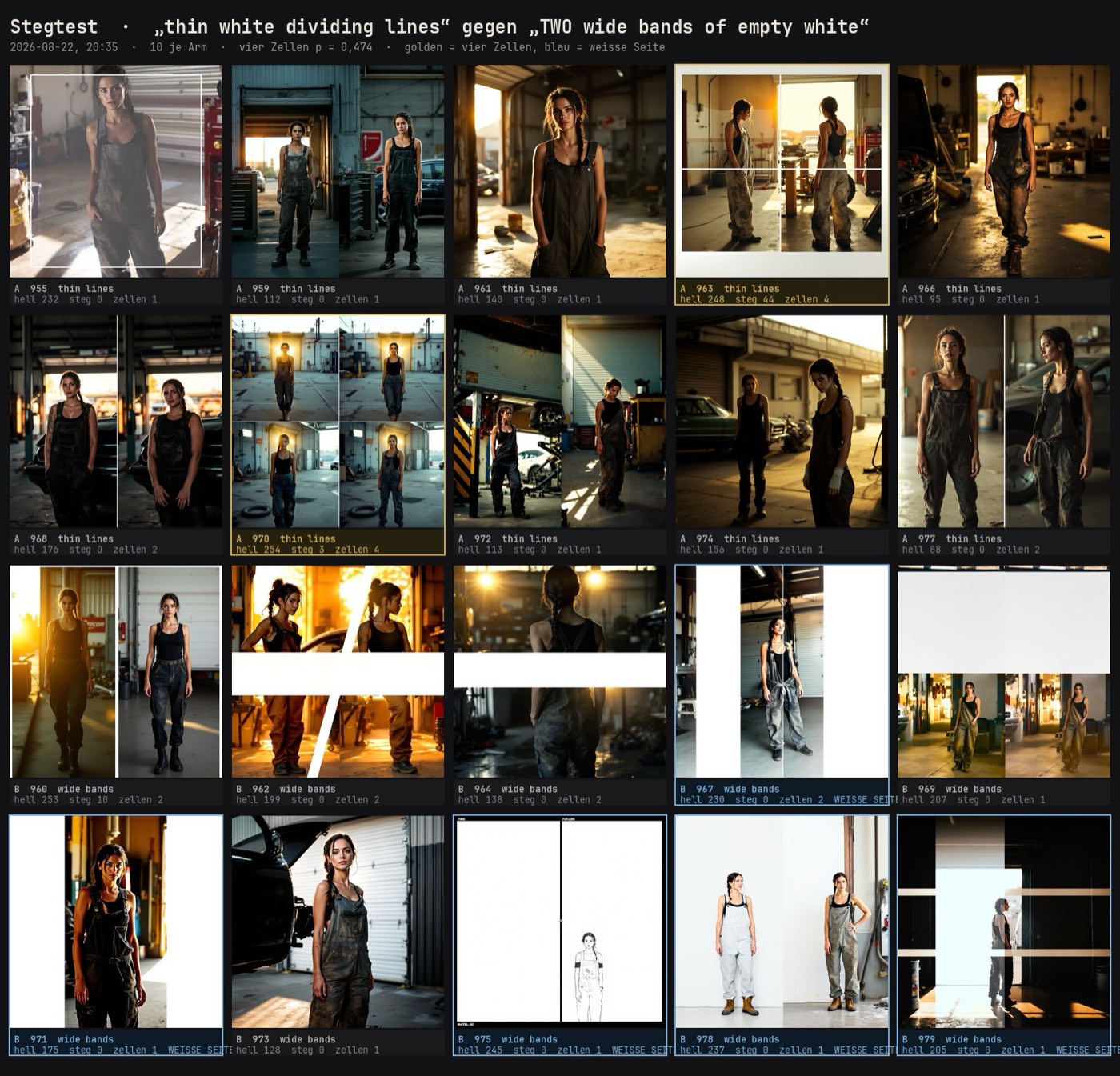
Always the same pattern: one question, two arms, thrown alternately in the same run — otherwise you measure the model's form on the day instead of the thing itself. At the end a contact sheet on which every throw stands with its measurements, so it is traceable what was counted.
What measuring costs. The night of August 22: 110 throws, about $8.80. The style round of September 2: 18 generations, $2.70. Together less than a single client job guessed wrong.
And why this is here. Because a tool that only shows its hits leaves you to find the gaps yourself — at worst the day before submission.
48 of them, all rendered on the same subject. Only that way is the difference the style and not the subject — and only that way do you notice when one does not do what it says.
Fifteen new graphic styles, every image looked at and every word in it read:
The most common deviation is harmless and recurring: the poster comes out as a photographed object instead of filling the frame. The rare one is not harmless — and the two cases are below.
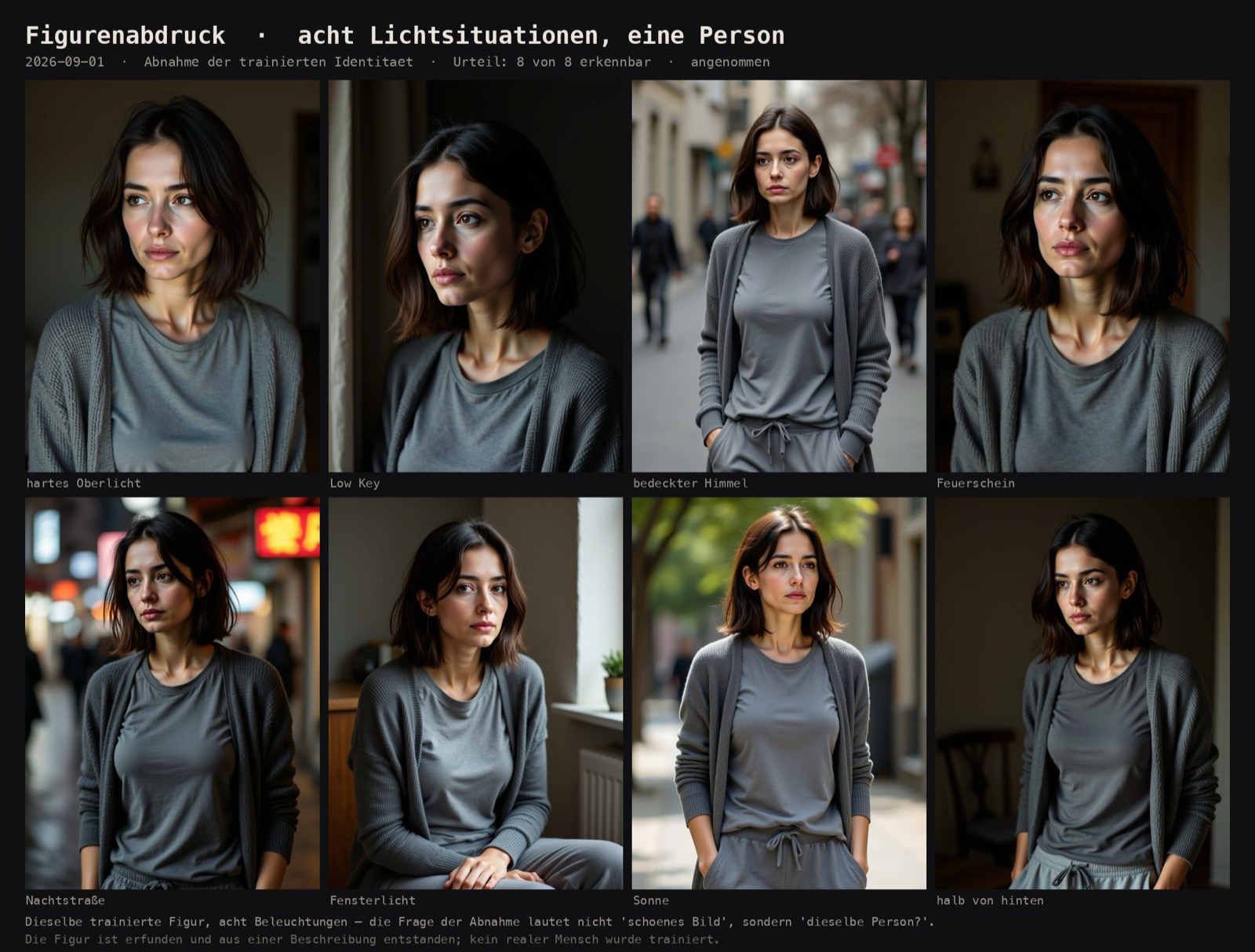
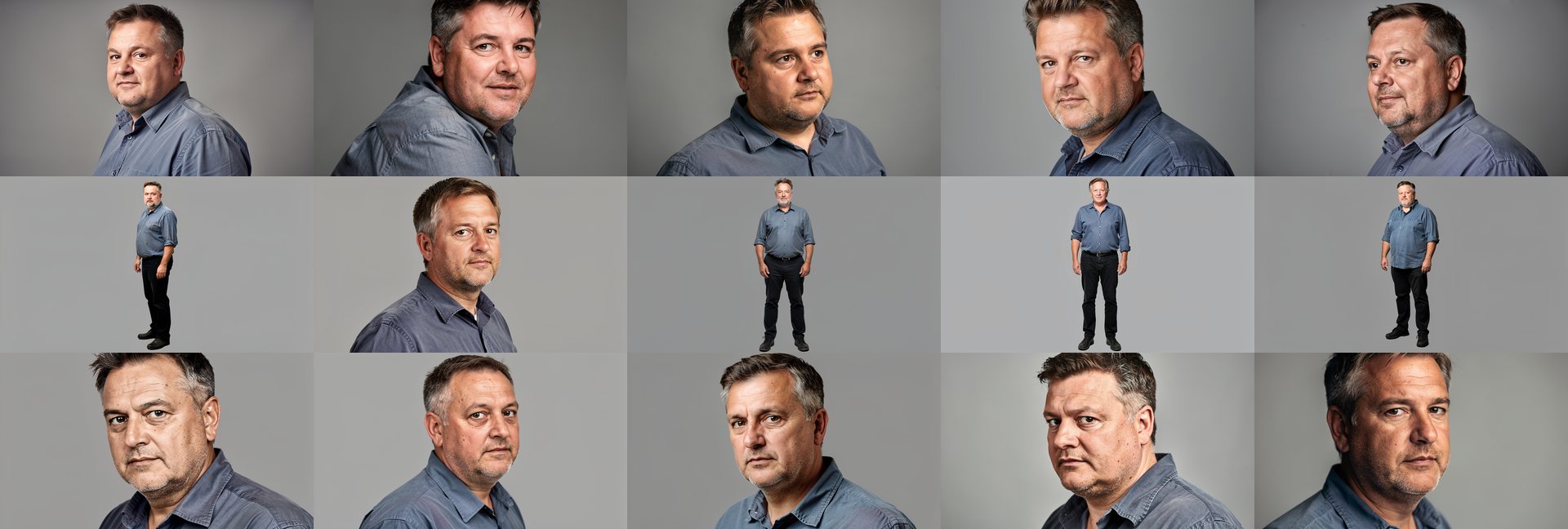
A character who looks different in the second image than in the first is not a character. The imprint is the trained identity: set up once, then available in every shot.
A character's identity is held by a reference image, not by repetition in the text. That works so well that it creates a problem of its own: the reference also overrides what it is not supposed to override. We measured when — on one character, four shots, ten runs per arm each, criterion set in advance.
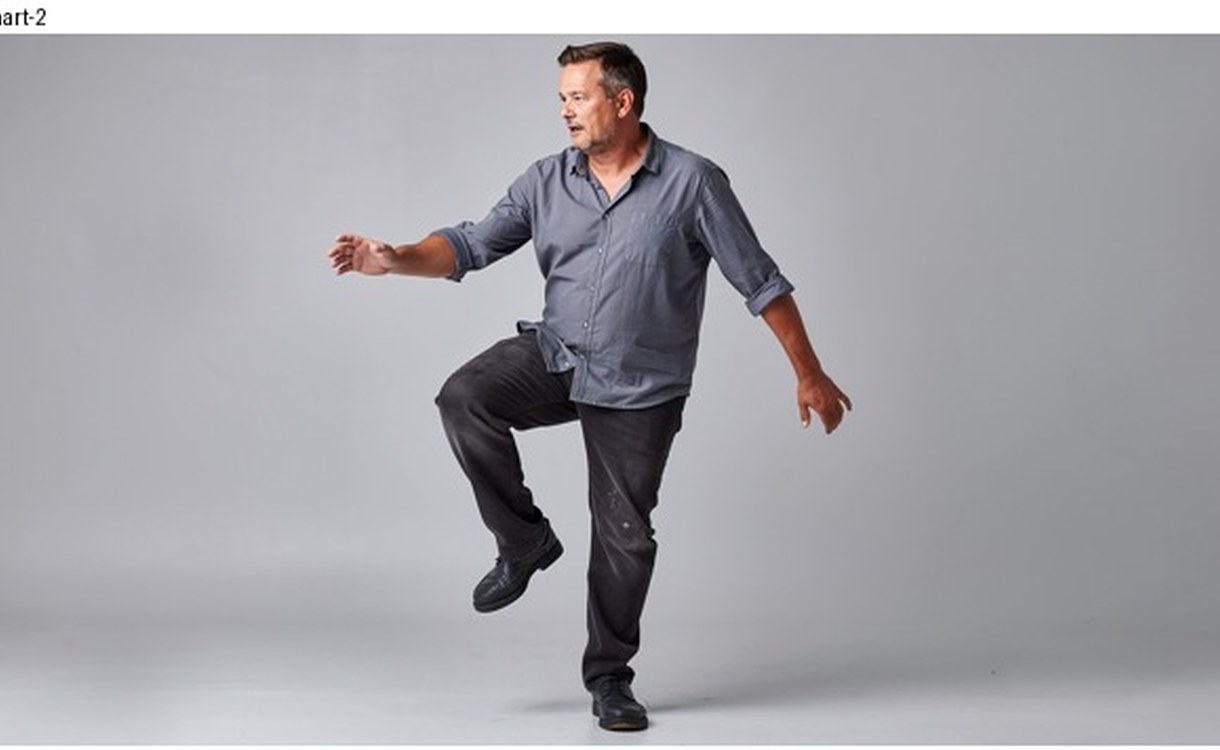
The two that broke were labels: “full side profile” and “dynamic action pose” — names for shots that a model hands out generously. The two that held were already describing mechanics: “hands resting on thighs”, “mid-stride toward camera”. The reference does not eat a posture. It eats a label.
In practice this means: points of conflict can be read from the wording instead of having to be measured one by one. If it states what should be visible, it holds. If it states the name of a shot, the reference image wins.
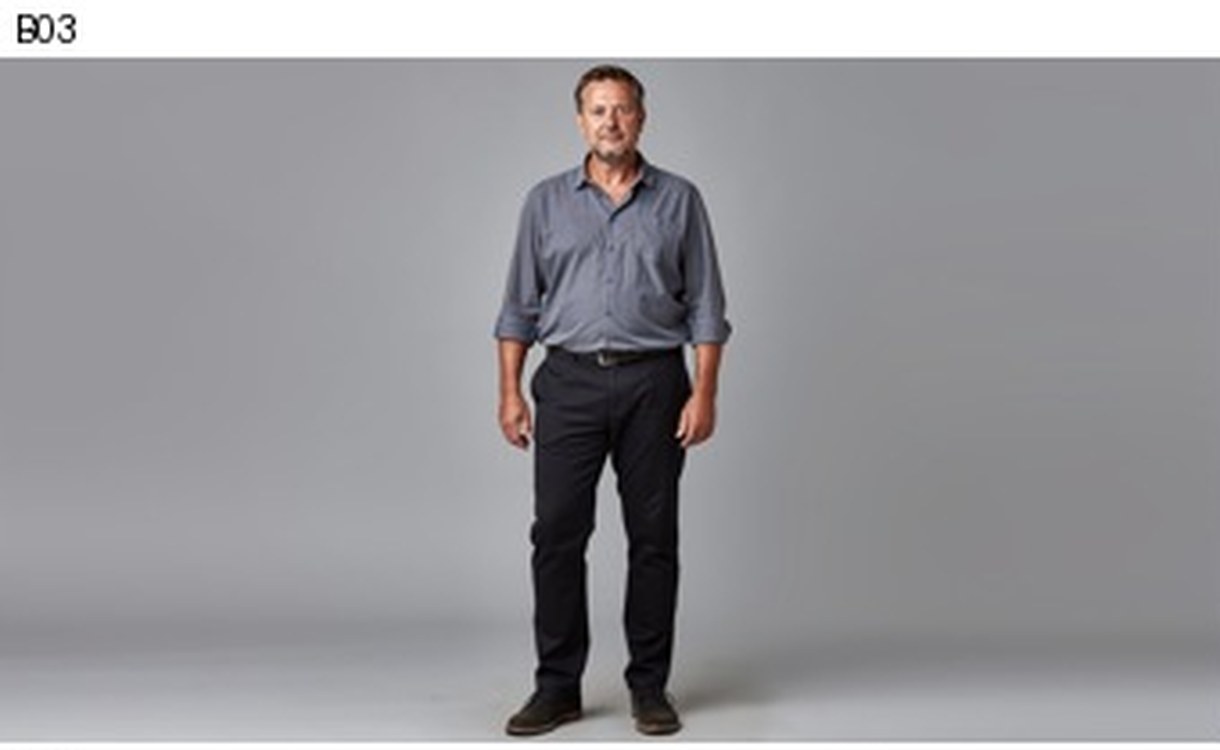
A sheet is a reference, not a finished image. Everything it contains in the way of light — a cast shadow, a floor fading to the horizon — is inherited by every following scene and has to fight the scene's light there. Until now the sheet views asked for a “gray background, even studio lighting”, in other words a photographed background. Since 2026-10-01 they ask for a color field: a uniform mid-gray at every pixel, with no floor, wall or horizon, lit without shadows, with no shadow and no light spill outside the character.
The measurement: “full body” view, three runs per arm, brightness of the image corners and a strip at the bottom against one at the head. Checked with a reference (anchor plus five further views, facial similarity against the anchor), the identity did not get worse: with the same anchor for both arms 0.684 → 0.735, a difference of +0.05 with a 95% interval of −0.01 to +0.12 (13 pairs). The gain comes almost entirely from the profile; without it the views are equal. That is “no loss”, not “a gain”.
The failure we had built in ourselves along the way.
With the color field, the detail anchor — the portrait from which all further views are derived — stopped being a portrait for many characters and became a half- or full-body image. We noticed it when we re-measured identity with a real character: in a run with a different anchor, “new” suddenly looked worse, and the cause was not the likeness but the framing. The character’s description text (here: “Standing at full length, the whole figure inside the frame, both shoes fully visible”, for another: “trousers and brown leather boots”) wins against the direction “large portrait”, and the sentence about “the character” in the color field does not help. It is the same mechanism as with label and geometry: the reference — here the text — overrules the direction.
Since 2026-10-02 the fix has been in the “detail” and “detail_smile” views: a sentence at the end that puts the head-and-shoulders crop above any framing in the description text. A face below 20% of the image height counts as full body. Limits: character 190 (real, ten runs per arm) and two invented test characters (five runs each) are a small sample; some crops are now very tight, and on one forehead the hair is cut off. We have not re-measured how well the follow-up views hold the identity with the new anchor. Sheets already saved do not change; if you got a full-body anchor, generate the sheet again.
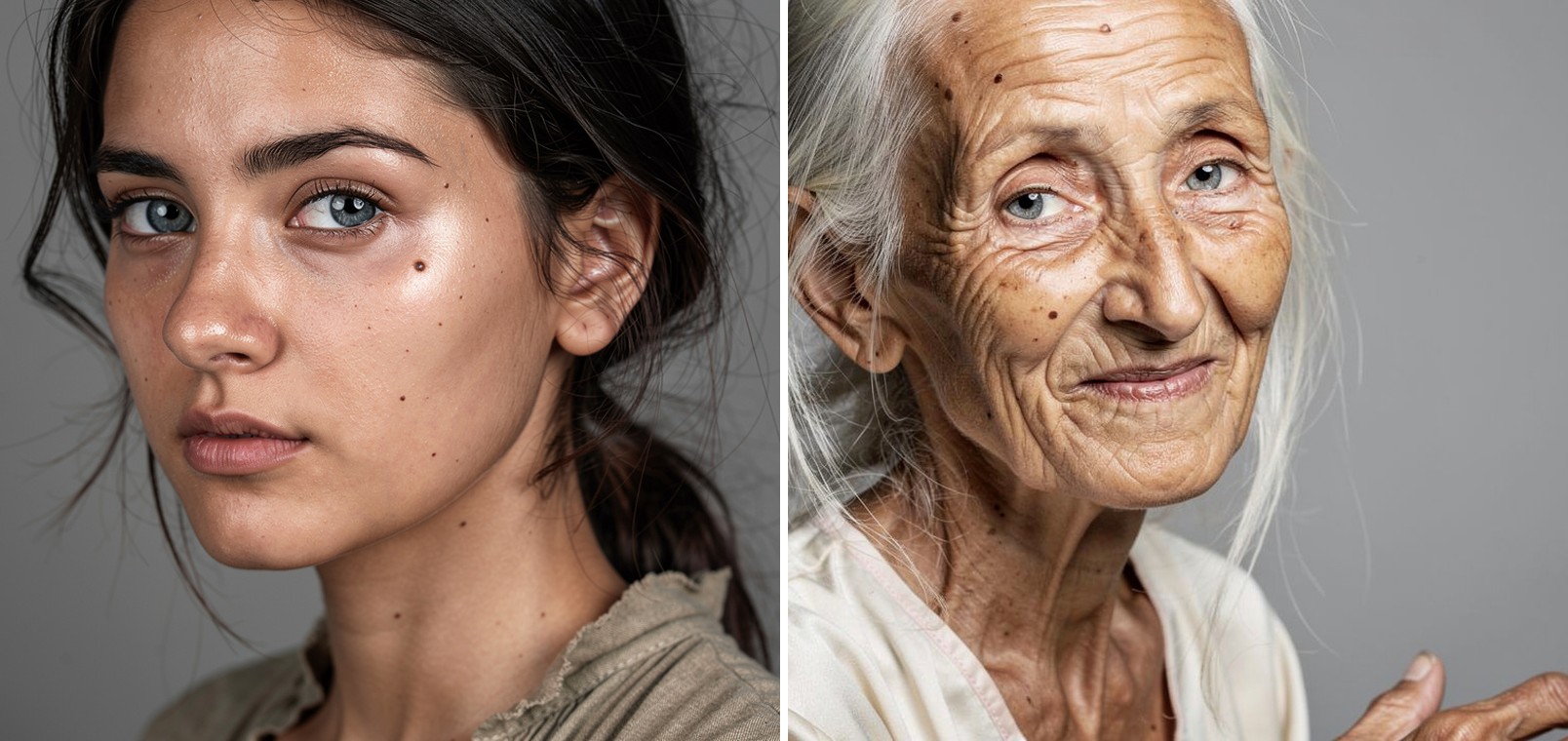
A screenplay required both for one character: a seventy-seven-year-old in bed and the same woman at twenty-eight, in flashbacks that carry a third of the episode. Two separate characters in the system — and so two faces that have nothing to do with each other.
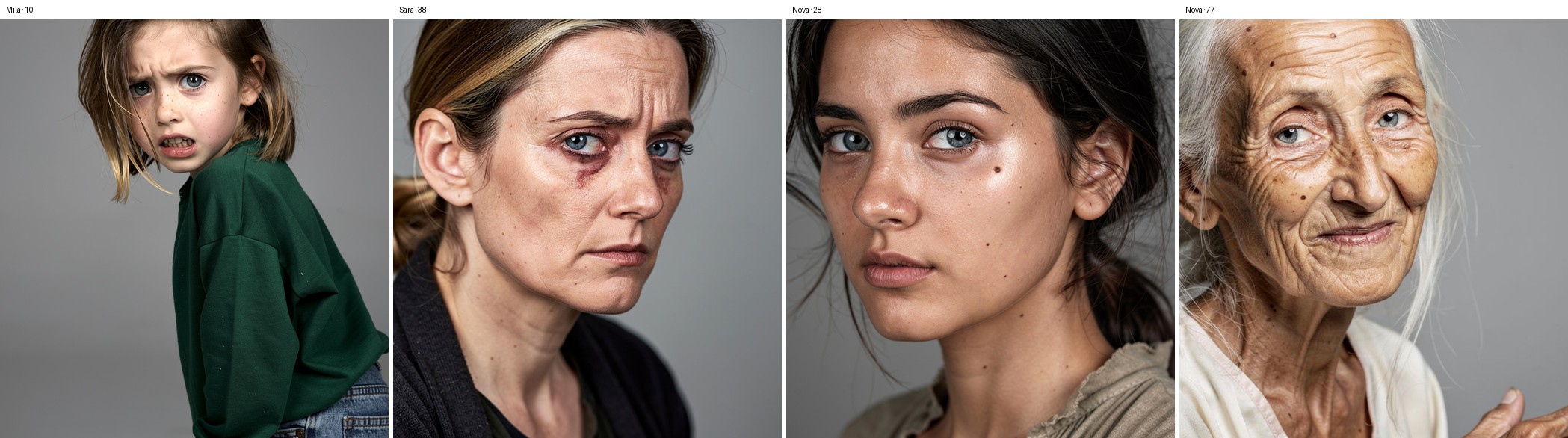
The same family across four sheets: daughter, mother, grandmother young, grandmother old. All four have the same eye color, and it visibly carries through.
“The same person, only younger” would not have carried anything — that is a label again. And the features must not be copied from the older character: “narrow face with high cheekbones” is carved by age on a seventy-seven-year-old and brings the age back with it. The first attempt promptly delivered a woman of fifty.
The descriptor is the text every image of a character is made from, and it is handwork — one in the collection runs to 1349 characters and was sharpened three times in one day. Until September 2 this column had no history: no modification date, no versions. A wrong overwrite was final, and the only safeguard was backup files created by hand.
Now the database itself records every version, with timestamp and origin. Deliberately in the database and not in the application: the repair tool that restored thirteen characters on the same day writes straight to the table and would have bypassed a safeguard in the application. A safeguard that only knows the known paths does not protect against the next tool. The existing records got their state at the time as a first version — 189 characters, so that the untouched ones have a history too.
Consent is a gate, not a checkbox. Every step checks for it, and the route with photos of a real person is built but cannot be used without an ID from the Likeness register. An imprint is a person's identity — it does not come about in passing.
And if consent is withdrawn? Then the path closes immediately — if the register cannot be reached, the gate also counts as closed, not open. Deletion, on the other hand, is not automatic but follows a review: a list tracks every imprint whose consent no longer holds and reports it again on every check run until it is gone. Since September 27, deletion also takes the training archive with the photos — before, it was left behind. What remains with the training provider after the run is beyond the reach of our deletion; it is stated here because otherwise nobody says it.
And what this one run cost us: eight bugs that no green test suite would have found — a timeout measured on the fastest model, a price that silently fell back to the reference value, a safety net for returning Credits that was skipped because the exception flew over it. All eight only came out of real runs with real money.
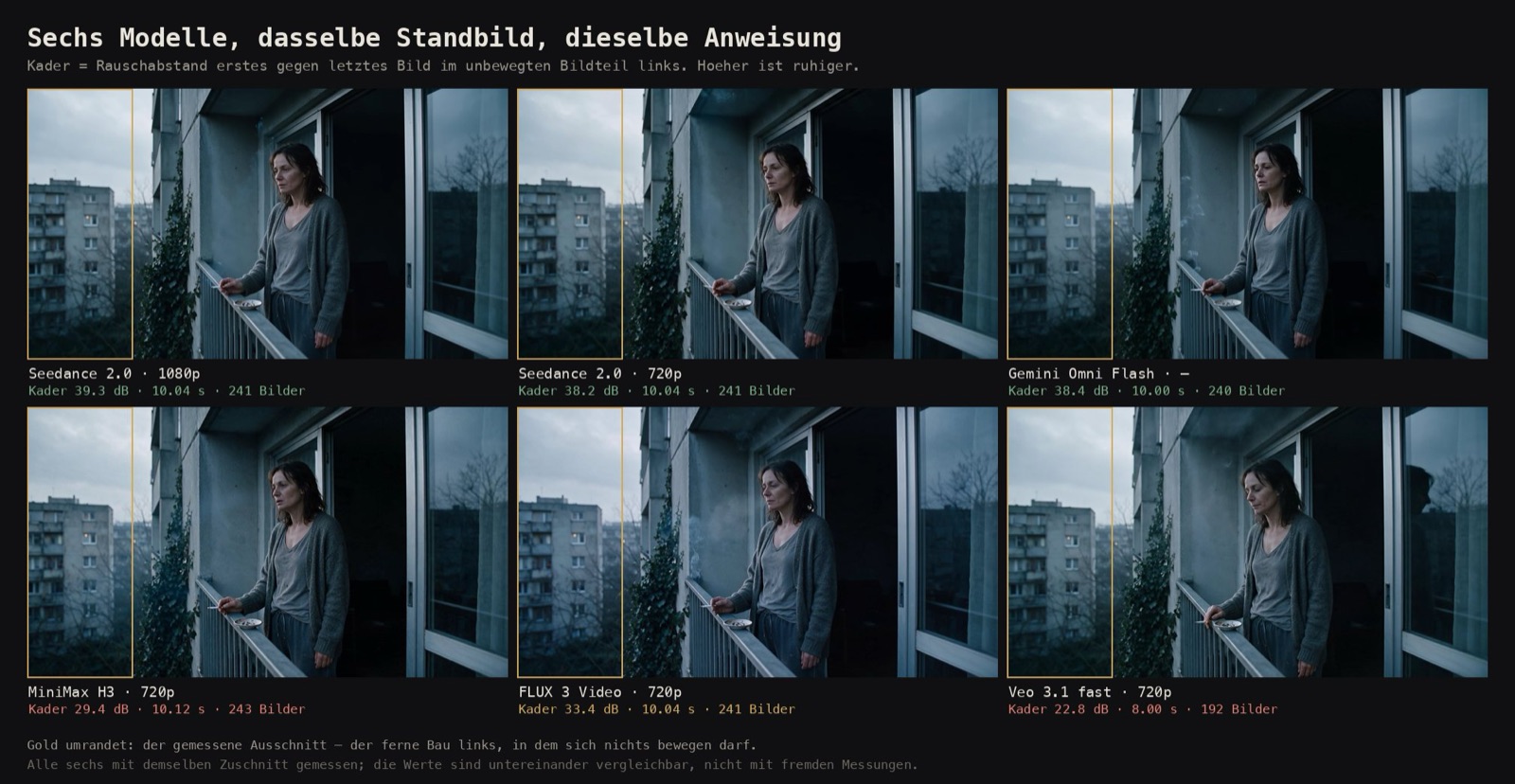
Setting a still image in motion is the step with the most money riding on it. That is why it is measured, not guessed.
What we measure is whether the frame really stands still: the signal-to-noise ratio between the first and last frame in the static part of the image on the left — where, according to the instruction, nothing may move. The higher the value, the steadier the camera.
| Model | Tier | Credits | delivered | Frame | Verdict |
|---|---|---|---|---|---|
| Seedance 2.5 * | 720p | 655 | 10,04 s | 43,3 dB | stands still |
| Seedance 2.0 | 1080p | 944 | 10,04 s | 39,3 dB | holds |
| Gemini Omni Flash | fest | 173 | 10,00 s | 38,4 dB | holds, with sound |
| Seedance 2.0 | 720p | 420 | 10,04 s | 38,2 dB | holds |
| FLUX 3 Video | 720p | 236 | 10,04 s | 33,4 dB | slight drift |
| MiniMax H3 | 720p | 83 | 10,12 s | 29,4 dB | drifts |
| Veo 3.1 fast | 720p | 139 | 8,00 s | 22,8 dB | drifts clearly, too short |
The table above measures a single property: whether the frame holds still. It does not decide how a model looks. Four typical runs, each without post-processing — to watch, not to compare: they are different subjects and different instructions.
Since September 2 the same four runs are also in the workbench, below the model selection in the “Video” stage. Until then you read thirteen model names there, each with one sentence of description, and chose blind — the files had been sitting ready next to it for four days, and nobody had linked them.
All measured with the same crop — comparable with each other, not with other people's measurements. * Seedance 2.5 was the only one to run on a different start image (a dark interior instead of the balcony, see below). Dark, low-detail areas raise the value; that is why the 43.3 dB stands next to the list, not in it.
The cheapest is not the worst, and the most expensive is not the best. MiniMax H3 costs a tenth of Seedance in 1080p and delivers the full length — just with a camera that drifts. For a mood shot that is enough; for a continuity sequence it is not. This is exactly the choice the router makes when you tell it what matters.
Ten seconds ordered, eight delivered — now for the second time. The first time, in 1080p, it was an observation. With a second run in 720p it is a pattern: Veo 3.1 fast cuts the clip short, and the full length is billed.
Seedance 2.5 rejects faces — and that matters more than its top score. The first attempt with the balcony still was rejected by the provider: the image might contain “likenesses of real people”. It shows an AI-generated woman; the provider cannot know that she is invented. Seedance 2.0 animated the same image twice without objection — the barrier is new in 2.5.
The counter-test answers the question. Same model, same job, but a start image without a visible face — the character from behind in an armchair, the identity passed as a reference instead of in the image. It went through, at full length, and held the frame steadier than anything else in the test. So the limit is not the model's ability but a content barrier: for close-ups of characters, Seedance 2.5 is unusable on the i2v route; for everything else it is the steadiest thing we have measured. That distinction belongs in the model choice, not in a surprise at runtime.
And one finding this run paid for itself: on fallback, the router correctly switched to Veo 3.1 fast, but 655 Credits were billed instead of 139. The fallback delivers the cheap model and bills the expensive one — a difference of 516 Credits on a single clip. Recorded, with reproduction and numbers, and being fixed.
And the resolution is rarely worth the money: the same clip in 720p instead of 1080p costs less than half, and the frame value is 1.1 dB lower — against a gap of 16 dB between the best and the weakest model. The choice of model decides, not the tier.
Start image, end image, reference images, a video as a template, sound as input or output: these differ from model to model more than the price does. Since September 27 each of the 42 video models carries its input roles, derived from the same table that builds the call — not from a description beside it. The end image field only appears where the model takes one.
The table found an error that the model list for agents had carried until then: three provider routes were listed as text-only models and in fact take a start image.
Seedance 2.5 also rejects faces as a reference. Above it says that the detour via a start image without a face works, with the identity as a reference. The probe on September 28 tested the reference itself: a reference image with a face is also rejected; a pure location image goes through. For characters, that leaves only Seedance 2.0 — or a model that drifts.
And the edit mode compresses time: 60 frames of template became 58. For a cut that has to join frame-accurately, that is an error, not a rounding detail.
If you only describe where someone stands, you rarely get it. If you put them there, you get it — that is measured, not claimed.
A gray blockout sets the camera move; the model is supposed to follow it. We measured how far the center of mass of the silhouette travels — that is, whether the camera really takes the planned path:
| Run | Center of mass travels | Camera follow |
|---|---|---|
| Control template (the blockout itself) | 7,48 px | 100 % |
| without image anchor | 6,53 px | 87 % |
| with image anchor | 1,69 px | 23 % |
The image anchor was the cause. A frontal reference photo overrides the camera move — it pins the image in place instead of taking it along. Without it, the model follows the blockout.
But the real swing is not the percentage: via the blockout, the full camera move needs six generations instead of 360. That is the difference between an afternoon and a week.
A street with twenty people is what a video model spoils most reliably: faces blur, people merge, half of them stand in mid-air. That is why extras here are not created in the model but as a layer of their own over the plate.
In the Composer step Layers: generate figures as cards, distribute them on the plate, render. The plate may be a still or a video with camera movement, the extras a still or a short clip with keying.
| Step | Credits | what happens |
|---|---|---|
| Extras card | 6 | Figure in portrait format, with feet — if they are missing, one more roll is made at our cost |
| Extras clip | 27 | 6 s, shot on green and keyed locally; “standing” or “conversation”; Credits returned if nothing is produced |
| Track camera | 0 | for moving plates; about one minute per five seconds of shot, with the verdict “trackable” or not |
| Occlusion, light, render | 0 | on our machines, 17–39 s for 12–30 figures |
The height. Without a reference point, the calculation assumes eye level as camera height — with a low angle, the crowd came out two and a half to three times too small. Now you click the foot and the top of the head of the main character and enter their height; the extras get theirs from it, 1.72 m on average, adjustable by slider between 70 and 130%.
The occlusion. If the main character stands in front of the crowd, the crowd has to disappear behind them. Four models tested for the person mask, one without false alarms — that one is built in. The same for objects: since September 26, columns, street lamps and kiosks occlude on their own, measured on one plate at 99.2% correctly cut out and 0.015% too much.
The tracking. On four AI-generated plates, the global reconstruction path captured three completely, the usual incremental one none, and tracking in Blender one of three. AI plates are harder for classic tracking than real footage; where it is not enough, the verdict says “not trackable” instead of delivering a sliding crowd.
Walking does not work. Zero of six walking clips showed a walk cycle. The crowd stands or talks; a crowd that walks is locked until a model can do it.
And three times the correction itself was the bug. Figures floated up to 7.7% of their height above the ground, extras measured 1.31–1.49 m instead of 1.72, and the camera was one twenty-fourth of a second off the image. Each of these spots had already been “fixed” once. Since then, a correction is measured before it counts as a correction.
Depth map. For every plate video a depth map, near bright and far dark as in Resolve, free of charge. Computed with Depth Anything V2 in the small version — the larger ones are under a license that excludes commercial use and are therefore locked. For objects it holds (100% correct), for people it does not: it orders people one behind another correctly in three of four images, in the difficult case only in every second one. The person mask therefore remains a separate path. The depth map is currently available through the MCP tool lab_depth_map and the Resolve bridge, not yet in the app.
Magic Mask as person mask. If you isolate the main character in Resolve more cleanly than the automatic process does, you send the matte back over the bridge; it then replaces the automatic mask and can be switched off again. The click on the character is made by a human in Resolve — points set by script did not produce a single image in six variants.
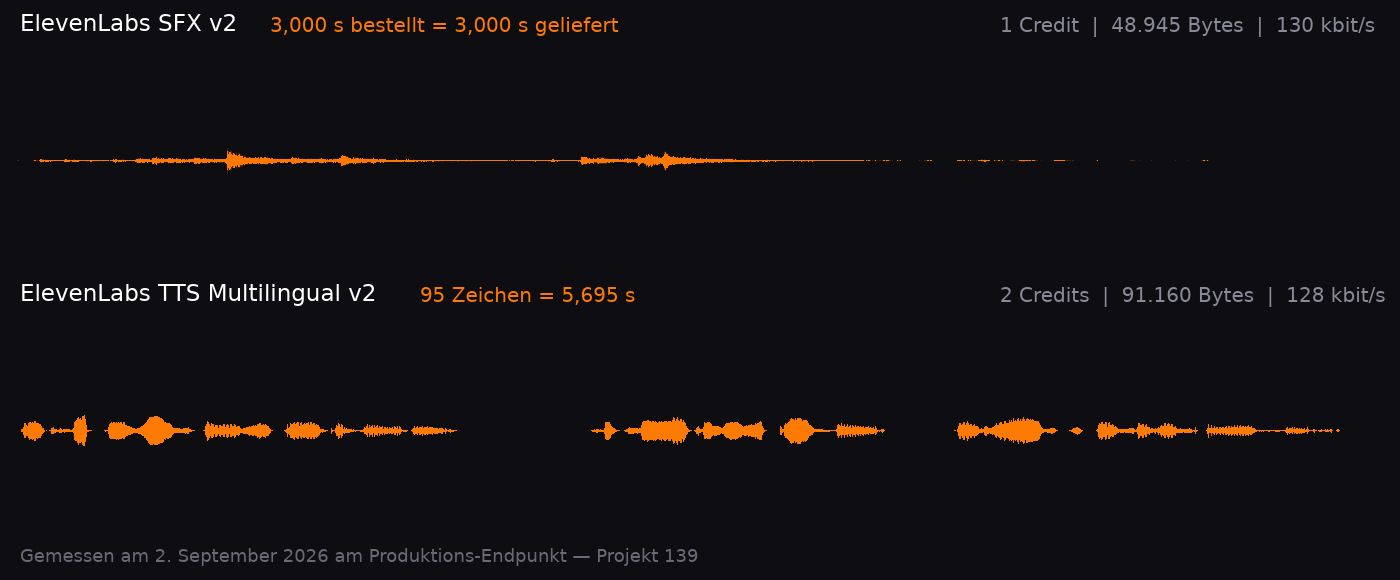
Stage ⑧ is called “Video + Sound”. Until September 2 the sound half offered five tools and had one. Suno, ElevenLabs, ElevenLabs SFX, Freesound were in the dropdown and answered with an error. A menu item that does nothing does not complain — it simply stops being clicked, and then nobody notices any more.
Now there are three, and all three work. Two were added (ElevenLabs SFX v2 for sound effects, ElevenLabs TTS Multilingual v2 for speech), two disappeared: Suno does not exist at our provider — the search returns a different maker with a similar name — and Freesound is not generation but a library. Searching, checking the license, carrying the attribution along is a different tool, not a checkbox in the same field.
| Tool | bills by | Example | Credits | for what |
|---|---|---|---|---|
| ElevenLabs SFX v2 | second | 3 s | 1 | Sound effects, 0.5–22 s |
| ElevenLabs TTS Multilingual v2 | 1000 characters | 95 characters | 2 | Speech, voiceover |
| Stable Audio 2.5 | Run | up to 190 s | 28 | Music, ambience, long beds |
Three tools, three billing units — and that is the point. Until September 2 every sound run cost the same: a flat price derived from Stable Audio, because for a long time there was nothing else. Under it, a three-second sound effect would have cost thirty times what it should.
This was noticed not through a complaint but while connecting the new tools: the price stood out before anyone paid it. With video, the same thing had gone the other way round a week earlier — there the payment came first and the calculation after.
Stage ⑨. Shots become a sequence. The computing for it costs nothing: nothing is generated here, only arranged.
Twelve look presets carry film titles instead of color values — Blade Runner 2049, In the Mood for Love, Grand Budapest Hotel, 2001, Chinatown, Tree of Life, Amélie, Mad Max: Fury Road, Moonlight, Parasite, Drive, Stalker. That is not coquetry: if you say “make it more like Moonlight” in the cutting room, you are understood, and a pair of numbers for color temperature and saturation is not.
| Block | Length | what it is |
|---|---|---|
| Title | 5 s | Title and subtitle; empty means project title |
| End credits | 8 s | Role and name, line by line |
| KI-Kennzeichnung | 4 s | Required under Art. 50(4) AI Act |
The third block is not an offer. Art. 50(4) of the AI Act requires disclosure for AI-generated people. That is why it is not in a checklist you can tick off, but a building block next to title and end credits — in the same place where you are working anyway, with pre-written text and four seconds on screen.
Honest addendum of September 28: “Required” on this block is a label, not a lock — an export without it is not refused. What cannot be deselected has sat one level deeper since September 25: every render with AI material carries the label in the image and in the file, whether the block is in or not. More on this under Provenance.
In Murnau, to the right of the editing area, there is a separate column with three input lines — Edit, VFX, Sound — and above it a small mark and the name IRO. Until September 17, 2026 it said “AI” there. The earlier name pointed to Lotte Reiniger, who in 1926 made the first feature-length animated film, Die Abenteuer des Prinzen Achmed — from cut black paper, lit from behind, the surfaces behind it colored by hand. Since October 2026 the assistant has been called IRO.
Since September 22, 2026 the mark has been a corridor: five dark bands moving outward on a glowing disc in ember orange. In 21 seconds the bands travel through six deep tones (dark brown, carmine, violet, night blue, petrol, fir green), and along their edges two colored fringes run against each other, the way a lens refracts red and blue by different amounts. They are not spectral colors, as this page said until September 28: on the bright orange none of them kept enough contrast, measured at 1.04:1 to 2.64:1. Dark on light remains Reiniger’s principle.
The seasons have stayed, unlike what this page said until September 28: Halloween, Christmas, Easter and New Year’s Eve color the disc, the figure stays the same. The Berlinale is only available via ?saison=berlinale — a festival date follows no formula. ?saison=aus forces the base tone.
The mark also says what is running at the moment. At rest, a band takes five seconds to move outward; while she answers, 1.35; while she reads, it moves backwards — she takes in instead of sending. When a suggestion is pending, the corridor winds up into a spiral that unwinds again over the suggestion’s validity (15 minutes). Once it reaches the core, the suggestion has expired. If you do not want to see motion, the system setting gives you a still image at full strength.
Until September 19, 2026 there were three buttons on this one line. Apply sent the text to a classifier, Ask to the assistant, Inspire was not a model at all but a list — and picked one of six fixed sentences at random. So the user had to decide before typing whether they wanted to change or to ask. That is a decision you can only make after the answer.
Now everything goes to IRO. That only works since IRO can suggest several cuts in one go and knows the sliders — before that, one verb would have cost the ability to hit any setting with an instruction. First the tool, then the operation.
The six prompts are offered as a selection below the empty field and disappear as soon as you type. A prompt next to a half-typed sentence is no longer an offer but a distraction.
All three panels showed the same assistant — even though FilmRadar has kept a whole cast since July: ten departments and twenty board versions, with names, careers and ways of thinking. Murnau simply could not reach them.
| Surface | Who is there | Department |
|---|---|---|
| Edit | Tarek Mansouri | Film editor, thinks in rhythm, ellipses, contrasts |
| Ton | Rafael Duarte | Composer and sound designer, thinks of both as one |
| VFX | Anders Marder | Cinematography — light, texture, color, space |
The mark stays with the assistant. The light corridor is the signature of the assistant, not the ID of a person — it now carries three names. If the registry fails, “IRO” appears again: the casting is enrichment, not operation. An editor that stops answering because someone else’s database is stuck would be a poor trade for a name.
In the registry they are reviewers — here they work. Every persona ends with “ALWAYS answer as JSON with exactly these fields: score, headline, strengths, concerns”. That is how they are built for ScriptLab's verdict tier. For Murnau exactly this part is cut off: only the person comes along, not the form. An operator who answers every instruction with a grade would be useless — and she would do it, because a contract in the prompt weighs more than any later request.
For one day the mark carried five states — scissors, film strip, finished cut, torn arc. At 36 pixels that was the wrong stage: what distinguishes reading, waiting for you and failed needs words, not a silhouette. And the star for the finished suggestion sat thirty pixels from the star of the Inspire button.
Today there are four states from a single figure — ready, thinking, reading, suggestion — told apart only by movement, never by a symbol. Everything precise sits at the field, where the eye already is while typing and where the full width is available: a bar along the bottom edge of the field while she works, the line below it for the answer, tools looked up and errors.
Murnau's /ai/interpret had three handwritten system prompts, each with its own list of what was not possible. Measured on 2026-09-17, the edit version was wrong on four of five points: it declared cutting, deleting, reordering and transitions impossible, although all four are in the editor.
To the user, this does not look like an interface limit but like a product limit. They ask once, read “does not exist”, and do not ask again. A list in prose goes out of date because no guard can compare two sentences; this one does not, because every entry carries a reference that scripts/ci/check_playbook_belege.py looks up in every pull request — in both directions. If you build splitClipAtFrame and leave the entry at nein, it turns red.
Since September 25, IRO also sits on the right in the Composer, the Workshop with the ten stages. There IRO reads what a person would check before a decision: where the project stands, what a step costs, which plan includes what, how much balance is left. When a stage is named, it is by its name and not by the internal key — during approval that was wrong once.
She suggests instead of acting, and separates two kinds:
If she cannot reliably look up the price, there is no paid suggestion — a button without a number on it does not get built. In any case, only what you click is carried out.
If a question needs a department, IRO brings it in by name: one of the ten crew roles, at most two per answer. If the casting fails, IRO answers directly instead of falling silent. And in Murnau, since September 24, IRO keeps a log — the last twelve answers, newest on top; before, each answer erased the previous one. Every step in it states its duration, including the failed one.
With the Resolve bridge she also knows the open Resolve timeline and can suggest depth and Magic Mask there. She does not suggest a clip there: that would need a source image, which does not exist at that point.
When IRO says something wrong, it can be taken back. The retraction does not land as a deletion but as a correction next to the source: a deleted piece of false information comes back at the next ingest, a corrected one does not. The correction carries the name of whoever wrote it — without an identity there is no way to write, and what you correct, nobody else sees.

Under each of the three bars sits a row of sliders. They look like controls, and until September 19, 2026 they were not: the value went into an object, the object traveled with the job as sliders, and in the prompt it ended up as a bare line —
{"pace":100,"tension":50,"rhythm":50,"flow":75}
no unit, no scale, not a word of explanation. Pace 0 and Pace 200 produced the same instruction. What the model made of it was down to luck.
| Slider | Range · Default | high means | low means |
|---|---|---|---|
| Pace | 0–200 · 100 | tighten — remove dead time, cut earlier | leave air, let pauses stand |
| Tension | 0–100 · 50 | cut on the movement, trim toward the end | let it breathe out, let it run out |
| Rhythm | 0–100 · 50 | even lengths, on the beat | deliberately uneven — long against short |
| Flow | 0–100 · 75 | soft transitions, J- and L-cuts | hard cuts, leave the breaks standing |
| Slider | Range · Default | high means | low means |
|---|---|---|---|
| Intensity | 0–100 · 100 | play it out fully | pull back — suggested |
| Blend | 0–100 · 100 | invisible — grain, color, light matched | visibly placed on top, as a separate element |
| Detail | 0–100 · 50 | hair and edges clean — slower, more expensive | keep it rough |
| Edge | 0–100 · 75 | hard, precise edge | soft and frayed — right for motion blur and hair |
| Slider | Range · Default | high means | low means |
|---|---|---|---|
| Loudness | −24…0 · −14 | louder toward 0 — social end | quieter — cinema and archive |
| Dynamics | 0–100 · 50 | keep quiet and loud apart | compress — evenly loud |
| Clarity | 0–100 · 60 | speech forward, noise back | leave the room unvarnished |
| Depth | 0–100 · 40 | allow reverb and depth | dry and close |
Loudness is not a matter of taste but a standard. These are LUFS, and the target values are already further down in this manual: −14 for web and YouTube, −12 for social, −24 for cinema and archive. Moving it there means choosing a delivery standard, not a sound color.
Exactly this slider was missed twice during the inventory — it is the only one with a negative range, and the measurement meant to find it did not allow a minus sign. In a count that only knows positive numbers, a slider with a negative range looks like no slider at all. The guard found it on its first run.
Only deviations. A slider at default is not an instruction but the absence of one — if it still appeared in the text, the one deviation that matters would be hidden among three irrelevant ones. If all are at default, the model gets the sentence “decide based on the material”.
Each bar sends its own group. Pace and Tension tell a compositing job nothing; before, the VFX bar would have been handed the edit meanings and found not a single one of its names in them.
And the meaning lives in one place, for both paths — the fast classifier and the tool loop. A slider that applies on one path and not on the other is worse than one that applies nowhere: you move it, see an effect, and the next time it does not happen.
Below the timeline there is an additional track, labeled CUES. It answers a question nobody else asks because it is too tedious: Did what the prompt says actually happen in the image?
A cue is a single statement from the prompt, bound to a window in the cut. “Hard cut at 00:01.50, camera on the hero, medium” is a cue. It does not sit beside the cut as a comment; it lies on the frames it applies to — and can therefore be compared with what is actually visible there.
Ten types, and two of them behave differently from the other eight. The first eight come from SceneFlow and each apply to a time window: dialogue, action, camera, shot, audio, vfx, transition, environment.
The other two apply to the whole clip. regel comes from POSITIVE CONSTRAINTS or RULES (“exactly three people, no fourth”), referenz sentence by sentence from ACTIVE REFERENCES (“@Video1 is the sole authority for camera, cuts and timing”). A rule has no window in which it applies — it always applies. That is why both appear in the track on the left as a count (@ 9 · § 7) and not as a block at one point.
Every cue carries a verdict. Four are possible, and the difference between the last two is the one that matters:
| Finding | Meaning | What it says about the model |
|---|---|---|
offen | nobody has looked yet | nothing — it is not a statement but the absence of one |
da | is in the image as written | the instruction got through |
fehlt | does not appear in the image | the instruction was ignored |
anders | something happens, but not that | the instruction was understood and reinterpreted |
The distinction is not hair-splitting. fehlt is cured with emphasis — the instruction clearer, earlier, repeated. anders is never cured that way: the model read the passage and decided differently. The only remedy is to rewrite the instruction. If you lump both together, you keep trying the wrong remedy until you consider the model useless.
The track label always names what is open first: “12 open · 31 there · 6 missing · 2 different (79%)”. A rate that hides twelve unchecked cues reads like a result and is an interim report.
The header of the prompt view reads “19 of 19 place(s) marked”. Both numbers look as if they ought to be equal. They are not, and the difference is the whole point of the display.
The second number belongs to the source clip and knows all its cues. The first belongs to this occurrence in the cut — and a trimmed clip does not contain the beats outside its window. On September 18, 2026 the header reported “19 places marked”; 17 were drawn: the occurrence had been trimmed to 19 of 96 frames, and two of the three beats fell out. The number was true for the source clip and false for what was on screen.
The missing ones are named, not hidden. If the tally is followed by “· 2 outside this cut”, that is the information an editor needs. Without it, they compare prompt and view, find two places too few and look for the mistake in their own work.
The prompt changes, the cues are read from it anew — and the verdicts would be gone. They are not: a finding is tied to type, wording and time window, not to its position in the text.
The character offsets explicitly do not count. They shift as soon as a character is added elsewhere in the prompt — and a verdict applies not to the position of a sentence but to what it says. What cannot be found again is not silently dropped: the response names befunde_übernommen and befunde_verworfen, so a loss gets noticed instead of disguising itself as an empty track.
What the track does not do: judge. It reads the cues from the prompt and calculates the window from the cut — the finding is set by a person who has looked at the image. There is no automatic approval and no rate that arises by itself. A machine that grades its own adherence to instructions is grading its own reading of the prompt.
Until September 23, the person in Murnau and an agent via MCP saw two different edits of the same sequence. Saving in the editor wrote to its own session, the agent read somewhere else.
Now every save, including the automatic one, writes the edit through to where the agent reads. If it overwrites the agent's work in doing so, the save line says what is gone — “3 agent clips overwritten (8 s, 2 transitions, 2 audio tracks)” — and first creates a state from which it can be recovered. That was necessary: on September 24, a single click overwrote a sequence with one clip, because with ten sequences in the project the editor had guessed which one was meant. The state saved it. Since then it no longer guesses: if the target is unclear, it asks.
The edit list as a table: track, source in and out, timeline in, duration, source, shot — in timecode. Video tracks only.
Give a saved state a name — in the header “States”, then “Save state”. Named versions never fall under the cap of 50 automatic states and do not count against it.
The list of saved states, and for each one on request: what changed? Who changed it — you or an agent — is shown alongside.
Viewing yes, restoring from this list not yetWhatever lies after the insertion point moves by the full duration; a clip that reaches across the point is split. Before, the button stacked them on top of each other — see above.
A sequence can be exported as OTIO and brought back in, for example back from another editing program. The way back always creates a new sequence and overwrites nothing; each clip's ID travels with it, so that it stays the same clip there and here.
Frame-accurate, not bit-identical. 5.5 seconds come back as 5.52 — 138 frames at 25 fps, because half a frame belongs to the length and must not disappear. If a clip is split over there, only the first piece keeps its ID.
And where the button is: nowhere yet. Both directions are built and tested; today they are reachable through the interface, not through the UI.
The Resolve bridge runs inside DaVinci Resolve, not next to it. That is not a question of style: Resolve from the App Store cannot be scripted from outside — the interface simply answers with nothing, measured on September 12. From inside it works.
Since September 27, the bridge and the MCP server form a shared facade. An agent — Claude at the desk, for example — sees FilmLab and the open timeline at the same time. Part of it is a viewer that shows the image under the playhead and can lay a depth map over it with a wipe — built, but not yet approved in every agent program.
| Page | Tools | of which writing |
|---|---|---|
| FilmLab (MCP) | 82 | Generate, grade, depth, edit — paid ones only with approval |
| Resolve (bridge 0.67) | 14 | 3: track Magic Mask, export matte, result to the timeline |
Each of the three writing Resolve tools first creates a duplicate of the timeline. An agent working in your edit should not be able to lose it.
A person makes the click. Magic Mask can be tracked and exported by script, but not started: points set in six variants did not produce a single image. You have to click the figure yourself.
And three limits from the first day: tracking only runs with the Fusion page open; the “Render completed” dialog halts Resolve until someone clicks it away; and a call has twenty seconds before the agent gives up.
Two steps where it costs money. An agent first gets the price in Credits and euros, then an approval token that is valid for exactly this call with exactly these parameters, once and for fifteen minutes. There is no back door for running arbitrary code in Resolve.
Stage ⑩. It costs no Credits either — the computing runs on our machines, not at a model provider.
An export is not “a file in one resolution”. It is a bundle of color space, dynamic range, codec, container and loudness — and loudness is the number most deliveries fail on, because it does not stand out in the editing software.
| Target | Color space | Codec | Resolution | Loudness |
|---|---|---|---|---|
| Web / FrameZero | sRGB · SDR | H.264 / MP4 | 1080p | −14 LUFS |
| Social (IG/TikTok) | sRGB · SDR | H.264 / MP4 | 1080×1920 | −12 LUFS |
| YouTube | Rec.709 · SDR | H.264 / MP4 | 2160p | −14 LUFS |
| Streaming HDR | Rec.2020 · HDR10 | H.265 / MP4 | 2160p | −14 LUFS |
| Cinema projection | DCI-P3 · HDR | ProRes / MOV | 4K DCI | −24 LUFS |
| Archive / master | Rec.2020 · HDR | ProRes 4444 | 4K | −24 LUFS |
Loudness is the difference that hurts. Ten decibels lie between social and cinema — −12 against −24 LUFS. If you upload a cinema mix to Instagram, it gets turned down and sounds thin; if you deliver the other way round, it fails approval. It is the same sequence, and they are two different files.
Across all six targets there are three quality tiers: Draft (half resolution, for a quick look), Standard and High Quality (double). The tier changes resolution and data rate, not the profile — color space and loudness stay where the target puts them.
A broadcaster, a festival, a funding body will at some point ask: what in this film is AI, and who approved it? Since September 26, the answer sits next to every film file — and can be verified without trusting us.
Every export comes with a provenance record, as a PDF for reading and as JSON for machines, with a link to the verification page. It sits next to the film file, not inside it: a record embedded in the file whose checksum it states would be circular.
| What it contains | What never becomes public |
|---|---|
| Checksum of the film file, duration, whether the label is in the image, approval with date | Prompts — only the project owner sees them |
| per clip: timecode, source, type (e.g. image to video), tool, provider, generation time | Consent IDs, email, account |
Verification works at seal.thefilmradar.com/herkunft: drag the file in, the browser computes its checksum, nothing is uploaded. The record is signed with a key whose public half is published there, plus two timestamps, one of them anchored in the Bitcoin blockchain. If you do not believe us, check it yourself with OpenSSL; the instructions are on the page.
Every render with AI material carries the mark “AI-altered” in the lower right corner and, in the file, the machine-readable IPTC note. That this was not true in Murnau until September 25, although the database claimed it, is described above. It was only noticed when someone checked the file instead of the field.
If an export contains a generated person (a clip based on a character) or a generated voice (voiceover, dialogue, dubbing), it stops before exporting and asks for a statement:
“I have looked at this export and approve it. It contains synthetically generated or altered people or voices.”
What is recorded is the account, the time and the version of this wording; the verification page shows only the date. Sound that a video model delivers on its own does not trigger an approval. And only a signed-in human in the interface can approve — an agent via MCP gets a refusal at this point. A statement that says “I have looked at it” is worthless if a machine can sign it.
What the record does not prove — and this is also stated on the verification page. The timecodes apply to the export from FilmLab, not to the broadcast version; conform, grading and transcode lie in between. The classification per clip follows what the system recorded at generation time, not a human’s judgment — and where it recorded nothing, it says “not recorded”, not a guess.
And what it is not: not a C2PA certificate with a chain to a certification authority. It is our own, openly documented record. Dubbed versions produced via the shortcut do not get one yet. It is kept in reduced form for ten years beyond the end of the contract, so that it can still be verified when the project has long been deleted.
Not every measurement ends in a feature. Some end with a route being closed — and that is the cheapest way to save money.
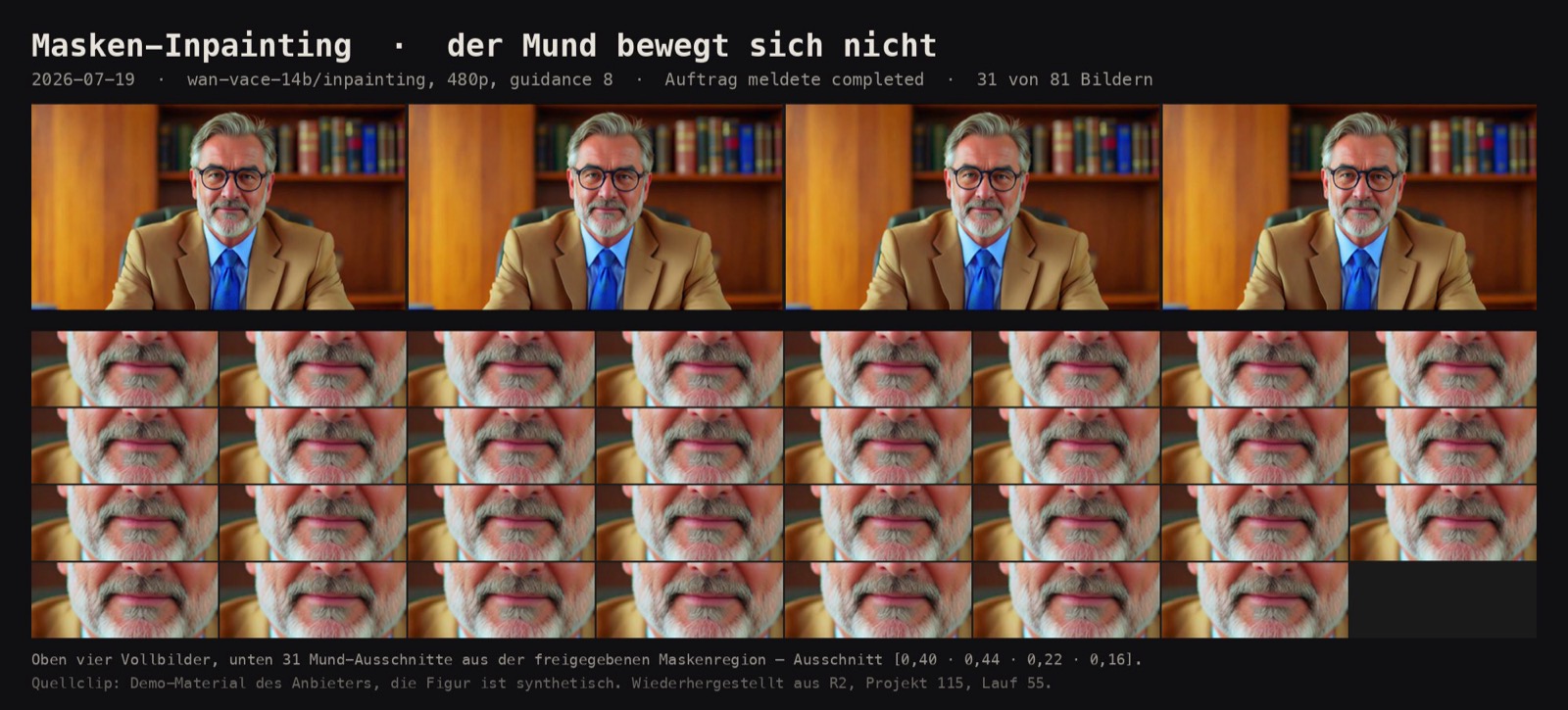
The question from July 19: can a released mouth region be regenerated via mask for lip movement while the rest of the image stays still? Three paid runs, each swapping exactly one variable:
| Run | Mask | Job status | Visible effect |
|---|---|---|---|
| Draft | static image | completed | none |
| high quality | static image | completed | none |
| Successor | real mask video, aligned frame for frame | completed | none |
All three reported success. In all three the mouth stayed closed — checked on a contact sheet of 31 frames, once in full and once as a mouth crop. Without that look, the route would have gone into the pipeline as “works”.
Since then, the lesson stands above everything here: a provider that documents a field has not yet delivered an effect. The status code says that something ran. Whether it did anything, only the image tells you.
Two presets did something nobody had ordered. Both errors were in the phrasing, not in the model — and both old versions remain selectable, so that nothing is pulled out from under anyone's hands.
The content filter of the image models is part of production planning. A character whose description contains self-harm — because the scene contains it — had six of six shots rejected. For another character exactly one shot failed, six times in a row: the checker reads the combination of “trembling hands, rigid posture as with mechanical breathing” and “walking toward the camera” as an emergency. That is not a random error that a second click fixes.
We do not rewrite such descriptions to outwit a filter. The character belongs to the screenplay, not to the provider. What we do instead: name the failure. Since 2026-09-02 the response states explicitly which shots were not created — before, they were simply missing from the list, and half a sheet looked like a whole one.
And for children the system describes no anatomy — on purpose. For adults it automatically carries the age as anatomy into every prompt: at thirty-four “first fine forehead lines, jawline still firm”, at seventy-seven “deeply furrowed face, drooping lids, age spots”. Under eighteen it carries nothing, and that is not a gap but a fixed limit of this product.
The price for this is real and belongs here: a ten-year-old came back twice as a five-year-old, although her description named ten-year-old proportions. Where the description is thin, the model sets its own age, and at this point the only thing that helps is careful handwork in the character fields — and looking.
Variance is real. The same prompt sometimes lands on the first attempt, sometimes only on the second. A failure on a hard style change is usually not a preset error but a second click.
And one limit that no text rule closes: factual errors. An overlay can call a hatchback small car “SEDAN” — a real, correctly spelled, wrong word. That only shows when you look.
Plans, Credit prices, your own keys and team seats are in the manual under “Pricing” — in one place, queried live, so that they do not drift apart in two places. Here only what was measured and why the cost model looks the way it does.
Until the morning of September 28, this page listed under Studio “three seats, shared projects, priority queue” — none of it was built, and the line was removed. Since that evening, both are in place.
Who pays is stated on every booking. What a member triggers in the Studio is deducted from the Studio balance and carries the member’s name; returned Credits go back to where they were charged — even if the membership has ended in the meantime. The previous return path credited whoever had triggered the job — in the Studio, that would have put the Studio’s Credits on the member’s account.
And a door that closed along the way: in Murnau, until September 28, any signed-in account could open any project that had been handed over from the Composer. The source code itself said this would only hold until the first real multi-user setup. Now the owner of the Composer project decides.
Until September 28, this page said “an image 5–6 Credits, an audio track 30” — the image figure applied to only two models, and the audio track had been cheaper since September 2 than this page said. Since then: an image 3 to 21 depending on the model, an audio track 28.
Until September 26, the cost line showed the purchase price at the model provider. That was a number nobody pays anything with; since then it shows Credits and the euro range a Credit costs depending on how it was bought.
The factor of six lies between models, not between providers. Measured: the same ten-second clip at 720p costs about six times as much with one model as with the other. That is why the router is the product and not the model zoo.
The price is shown before you submit. This is not a convenience but a paid lesson: a test day without preflight cost $45 where $7.50 would have been enough.